
mya-moe history
The birth of Mya-Moe attests to the old addage that "necessity is the mother of invention." Okay, so Gordon may not have invented the resonator ukulele, but he started building them when Moe Dixon, an owner of one of Gordon's early guitars, asked if he'd build a resonator ukulele. That instrument was delivered 3 months later. Within a very short period of time, the demand for ukuleles was so great that Gordon stopped building other instruments, and Char turned her attention towards helping out in the shop.
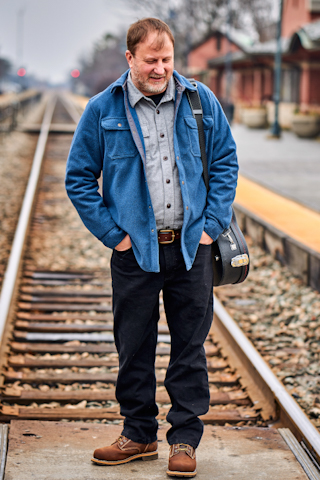
With the shift in focus, Gordon's lutherie business, Broken M Acoustics, became Mya-Moe Ukuleles. The name comes from a play on Mayer, Gordon & Char's last name and Moe's name, as Moe was the inspiration for the switch. Moe played & tested many of our early instruments & heads up our artist series.
The adventure began in early 2008 and today, Gordon & Char start and finish 1 ukulele every day. They have combined expertise in design, engineering, music, and lutherie. They both have masters degrees in engineering. Prior to building ukuleles, Gordon had been building guitars & mandolins for 7 years. Char is a professional musician. Before building guitars, Gordon was a wood-turning artist, giving him extended knowledge of different woods & their properties. Char’s artistic bent was expressed in hand-pieced Roman shades. Together, they hand-craft each instrument, a culmination of their combined educations & experiences in engineering, art & music.
While Gordon's initial focus was on conquering the engineering challenges of the resonator, he & Char also worked to build an impeccable classic tenor. This was accomplished by collaborating with 3 other artists - Peter Luongo, director of the Langley Ukulele Ensemble and his son, Paul and Eugene player, Craig Chee. As a result, the neck & headstock were modified and the internal bracing was redesigned to bring a consistently broader, larger voice to the Mya-Moe Classic.
Soon thereafter, James Hill asked Gordon to build a wood body, lap steel tenor. Gordon embraced this subsequent engineering challenge. Steel strings & the height of the action over the neck delivered much more downward force onto the resonator cone. Much thanks to Ben Bonham, one of the earliest members of our artists program, and Don Young, owner of National Reso-Phonic Guitars who gave invaluable advice on overall design. The first publicly-available lap steel was offered at the Denver UkeFest in February of 2009. It got an enthusiastic thumbs-up from Matsui-san of The Sweet Hollywaiians. Be sure to listen to Ben playing what is definitely the loudest instrument Mya-Moe offers.
The collaborations continued to come our way. The next was with Portland artist, Kate Power. While she plays a variety of instruments, her ukulele of choice is a Lili'u six-string. Another engineering challenge and 8 weeks later, the Mya-Moe Six-String Tenor was delivered. Neck width, string spacing & a custom combination of D'Addario nylon & wound strings was the result of the input from Kate. With the Mya-Moe Six-String, you get the depth & sustain from the wound bass strings combined with the attack & presence of the nylon treble strings.
In mid-2009 we made two major decisions--to develop sizes other than tenors, and to develop a lower-cost model. We collaborated with Brook Adams and Marianne Brogan to develop the soprano, and soon thereafter developed a concert-sized instrument. We again worked with Peter Luongo to develop the specifications for the Tradition, our entry-level model. And then we teamed up with Ralph Shaw to develop the baritone.
What's next? Only time will tell.
Models aside, we strive everyday to build instruments that are so easy & fun to play that our owners will not want to put them down!


